
If you spend most of your working day at a desk, in front of a screen or behind the wheel of a car, there's a good chance your shoulders are carrying more tension than they should. Shoulder tightness after long desk sessions is one of the most commonly reported physical complaints among office workers, remote workers, drivers and people who train their upper body regularly.
The good news is that a few simple habits — built consistently into your daily and evening routine — can make a meaningful difference to how your shoulders feel. This guide walks through why shoulder tension builds up, what you can do about it and how wearable recovery tools can support a calmer, more comfortable routine.
Why Shoulders Often Feel Tense After Desk Work
The shoulders are not designed to stay in one position for extended periods. When you sit at a desk, type on a keyboard or look at a screen for hours at a time, the muscles of the upper back, neck and shoulders are held in a sustained, often slightly elevated or forward position. Over time, this static load causes the surrounding muscles to fatigue and tighten.
Unlike dynamic exercise — where muscles contract and relax repeatedly — sustained static postures keep muscles under continuous low-level tension without the natural release that comes from movement. This is one of the primary reasons desk workers often feel more shoulder tension at the end of a working day than people in more physically active roles.
Common contributing factors include:
- Prolonged sitting with the shoulders raised or rounded forward
- Reaching forward to a keyboard or mouse that is too far away
- Looking at a screen that is too low, too high or off to one side
- Holding a phone between the ear and shoulder
- Driving for extended periods with hands gripping the wheel
- Upper body training without adequate recovery time between sessions
How Posture and Screen Habits Can Contribute
Posture during desk work plays a significant role in how the shoulders feel by the end of the day. A 2019 review published in Applied Ergonomics found that prolonged static postures during computer work were consistently associated with increased muscle tension and discomfort in the neck and shoulder region.
A few screen and workstation habits that can help reduce the build-up of shoulder tension during the working day:
- Screen height — Position your monitor so the top of the screen is roughly at eye level. Looking down at a screen for hours pulls the head forward and loads the upper back and shoulders.
- Keyboard and mouse position — Keep your keyboard and mouse close enough that your elbows are at roughly 90 degrees and your shoulders are relaxed, not raised or reaching forward.
- Chair height — Sit with your feet flat on the floor and your hips at roughly 90 degrees. A chair that is too low or too high changes the angle of the whole upper body.
- Laptop use — Laptops are particularly problematic for shoulder and neck tension because the screen and keyboard are fixed together. Using a separate keyboard and raising the laptop screen to eye level can make a significant difference.
- Phone habits — Avoid cradling a phone between your ear and shoulder. Use a headset or speakerphone for longer calls.
The NHS provides workplace ergonomics guidance at nhs.uk, and the Health and Safety Executive (HSE) publishes detailed workstation setup guidance for desk workers in the UK.
Simple Movement Breaks
One of the most effective ways to reduce the build-up of shoulder tension during a working day is to break up prolonged sitting with regular movement. Research consistently shows that short, frequent movement breaks are more effective at reducing muscle tension than longer, less frequent breaks.
A 2015 study published in the Journal of Physical Activity and Health found that breaking up prolonged sitting with short bouts of light activity was associated with reduced musculoskeletal discomfort in office workers.
Simple movement habits to build into your working day:
- Stand up every 30 to 60 minutes — Set a timer if needed. Even standing for 2 minutes and moving your arms gently can help reset the shoulders.
- Shoulder rolls — Roll your shoulders slowly backwards 5 to 10 times. This helps release the static tension that builds up during sustained desk postures.
- Neck tilts and gentle rotations — Slowly tilt your head to each side and gently rotate left and right to ease tension in the neck and upper trapezius.
- Chest opener stretch — Clasp your hands behind your back and gently open the chest. This counteracts the forward rounding that builds up during desk work.
- Walk during calls — If you're on a phone or video call that doesn't require screen sharing, stand up and walk around during the call.
Evening Recovery Routines
What you do in the hours after a long desk day matters as much as what you do during it. An intentional evening recovery routine — even a short one — can help the shoulders feel significantly more relaxed before sleep and reduce the carry-over of tension into the following day.
A simple evening shoulder recovery routine might include:
- 5 to 10 minutes of gentle stretching — Focus on the chest, upper back and shoulders. A doorway chest stretch, cross-body shoulder stretch and upper trapezius stretch are all practical and effective.
- Foam rolling the upper back — Gently rolling the thoracic spine and upper back can help ease the feeling of tightness that builds up during the day.
- Targeted warmth — Applying gentle heat to the shoulder area can help the surrounding muscles feel more relaxed and at ease before sleep (see the next section).
- Reducing screen time before bed — Continued screen use in the evening keeps the shoulders in the same forward posture they've been in all day. Reducing screen time in the hour before bed supports both shoulder recovery and sleep quality.
Using Targeted Warmth as Part of Relaxation
Heat therapy is one of the most widely used tools for supporting muscle relaxation and comfort after sustained physical or postural load. Applied to the shoulder area, gentle warmth can help the surrounding muscles feel more at ease and support a sense of relaxation — making it a practical addition to an evening recovery routine.
Heat is generally considered most useful after the working day has ended, as part of a wind-down routine rather than during active work. Many people find that a 20 to 30 minute heat session on the shoulders in the evening helps them feel more settled and comfortable before sleep.
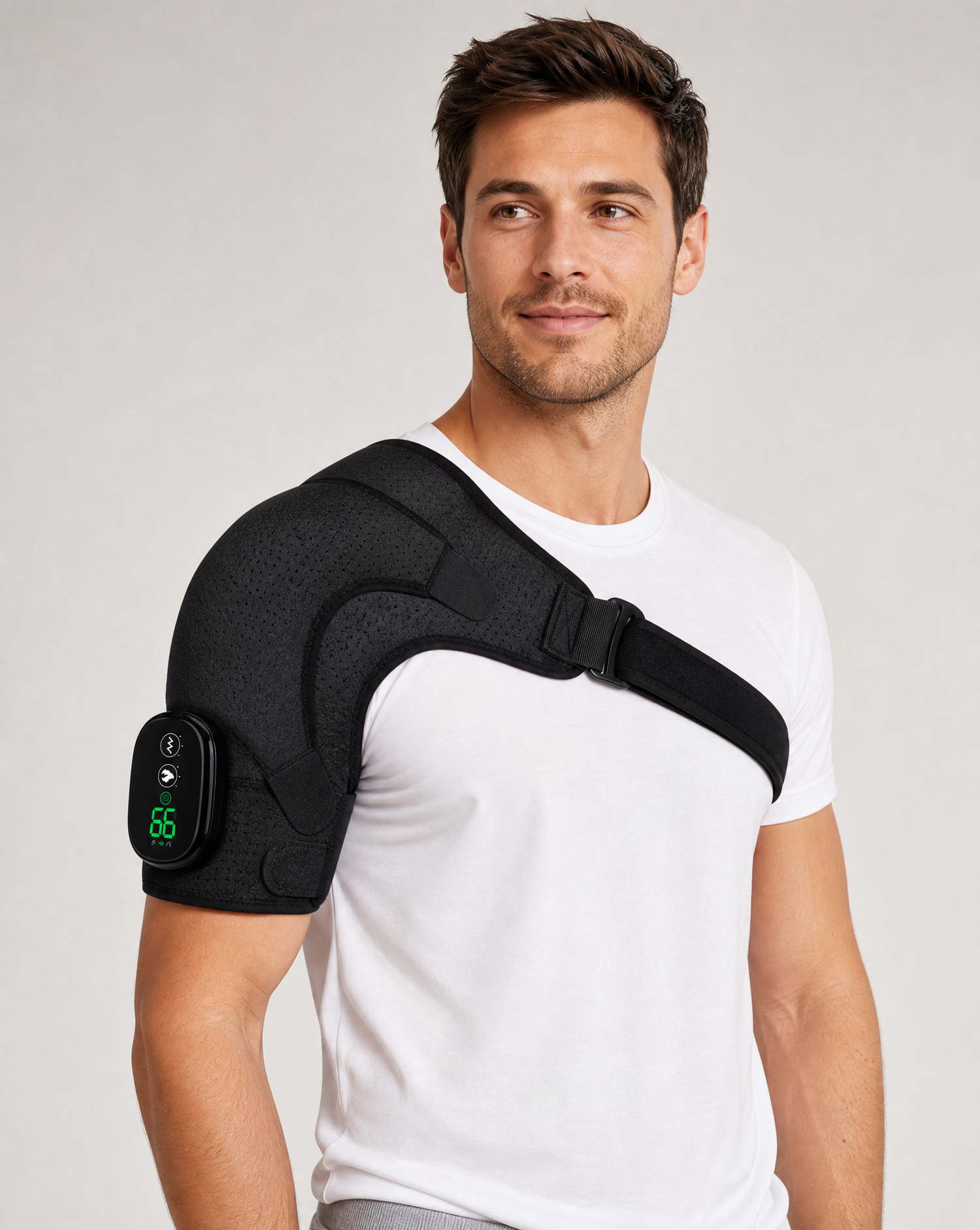
The PhasePulse™ Shoulder Recovery System from Phase One Recovery is a wearable heat and vibration-style recovery support designed to wrap around the shoulder area and deliver targeted warmth and gentle vibration as part of a home recovery routine. Wireless and rechargeable, it's designed to be used hands-free at home — while resting, reading or winding down after a long day — without any professional setup required.
Explore the PhasePulse™ Shoulder Recovery System →
How Wearable Shoulder Support Can Fit Into Daily Life
One of the biggest barriers to consistent recovery is time. Most people don't have the schedule to book regular massage appointments or physiotherapy sessions around a busy working life. Wearable recovery systems are designed to remove that barrier by making targeted recovery support accessible at home, on your own schedule.
A wearable shoulder recovery system can fit into daily life in a number of practical ways:
- Evening wind-down — Use it for 20 to 30 minutes while watching TV, reading or relaxing after work.
- Post-training recovery — After upper body training sessions, a heat and vibration session can support the shoulders as part of a cool-down routine.
- Rest day recovery — Build a short shoulder recovery session into rest days as part of a structured weekly routine.
- Travel recovery — After long drives or flights, a wearable shoulder wrap can help ease the tension that builds up from sustained seated postures.
The key is consistency. A short, regular session built into your routine will generally deliver more benefit than occasional longer sessions. Having a dedicated wearable tool makes that consistency significantly easier to maintain.
When to Speak to a Healthcare Professional
Shoulder tension from desk work is common and generally manageable with good habits and a consistent recovery routine. However, there are situations where it's important to seek professional advice rather than relying on home recovery tools alone.
Speak to your GP or a qualified healthcare professional if you experience:
- Shoulder discomfort that is severe, sudden or does not ease with rest
- Discomfort that radiates down the arm, into the hand or is accompanied by numbness or tingling
- Visible swelling, redness or warmth around the shoulder joint
- A feeling of weakness or instability in the shoulder or arm
- Symptoms that persist for more than a few days or are getting progressively worse
- Any shoulder symptoms following a fall, collision or acute injury
The NHS provides guidance on shoulder conditions and when to seek medical attention at nhs.uk/conditions/shoulder-pain.
Home recovery tools — including wearable heat and vibration systems — are general wellness and comfort tools. They are not medical devices and are not a substitute for professional medical assessment or treatment.
Build Your Shoulder Recovery Routine
Shoulder tension from desk work doesn't have to be something you simply put up with. Regular movement breaks, a simple evening stretching routine, targeted warmth and a consistent recovery habit can make a real difference to how your shoulders feel — day to day and over the long term.
If you're looking for a wearable recovery tool to support your shoulder routine at home, explore the PhasePulse™ Shoulder Recovery System and the full Phase One Recovery upper-body range.
Shop the PhasePulse™ Shoulder Recovery System →
Explore All Phase One Recovery Systems →
References
The following sources were used to inform the general context of this article. This article does not make medical claims and is intended for general wellness and informational purposes only.
- Andersen, L. L., Christensen, K. B., Holtermann, A., Poulsen, O. M., Sjøgaard, G., Pedersen, M. T., & Hansen, E. A. (2010). Effect of physical exercise interventions on musculoskeletal pain in all body regions among office workers: A one-year randomized controlled trial. Manual Therapy, 15(1), 100–104. https://doi.org/10.1016/j.math.2009.08.004
- Straker, L., Coenen, P., Dunstan, D., Gilson, N., & Healy, G. (2016). Sedentary Work: Evidence on an Emergent Work Health and Safety Issue. Safe Work Australia. Retrieved from https://www.safeworkaustralia.gov.au
- Thorp, A. A., Owen, N., Neuhaus, M., & Dunstan, D. W. (2011). Sedentary behaviors and subsequent health outcomes in adults: A systematic review of longitudinal studies, 1996–2011. American Journal of Preventive Medicine, 41(2), 207–215. https://doi.org/10.1016/j.amepre.2011.05.004
- Hedge, A. (2019). Ergonomic Workplace Design for Health, Wellness, and Productivity. CRC Press. ISBN: 9781138055308.
- NHS. (2023). Shoulder pain. NHS. Retrieved from https://www.nhs.uk/conditions/shoulder-pain/
- Mayo Clinic. (2023). Shoulder pain: Symptoms and causes. Mayo Clinic. Retrieved from https://www.mayoclinic.org/symptoms/shoulder-pain/basics/causes/sym-20050696
- Health and Safety Executive (HSE). (2023). Working with display screen equipment (DSE). HSE. Retrieved from https://www.hse.gov.uk/msd/dse/
Phase One Recovery products are general wellness tools and are not medical devices. Always consult a qualified healthcare professional before beginning any new recovery routine, particularly if you have an existing health condition or have experienced a shoulder injury.

Leave a comment
This site is protected by hCaptcha and the hCaptcha Privacy Policy and Terms of Service apply.