
Introduction
Home recovery has changed. Where once a hot shower and a rest day were the extent of most people's post-training routine, more people are now building structured recovery setups at home — combining heat, compression-style support and controlled cold-water exposure to support how they feel day to day.
Phase One Recovery is built around that idea: practical, wearable recovery systems designed for real life. Our range covers heat therapy, compression-style support and, now, cold recovery — with the introduction of the PhaseChill™ Portable Ice Bath Recovery Tub.
In this article, we cover what cold-water recovery is, why people use ice baths as part of a recovery routine, what the research currently suggests, and how to use cold exposure responsibly at home.
What Is Cold-Water Recovery?
Cold-water recovery — sometimes called cold-water immersion or cold exposure — involves submerging part or all of the body in cold water as part of a structured recovery routine.
It has been used in sport and active lifestyle settings for many years, typically after training sessions, matches or physically demanding days. The practice involves controlled exposure to cold water, often with ice added to lower the temperature further, for a set period of time.
Cold-water recovery is not a medical treatment. It is a general wellness and recovery practice used by athletes, gym users, runners and active people as part of a broader home recovery routine.
Why Do People Use Ice Baths?
People incorporate ice baths into their recovery routines for a range of reasons. Common motivations include:
- Post-training recovery routines — used after gym sessions, runs, sport or high-output training days as part of a structured wind-down
- Sport and gym recovery setups — football players, runners and gym users often use cold-water immersion as a regular part of their recovery week
- Active lifestyle recovery — people with physically demanding jobs or active daily routines use cold exposure to support how they feel after long days on their feet
- Home recovery habits — as home gym setups have grown, so has interest in building a complete home recovery routine that goes beyond stretching
- Mental reset and controlled cold exposure — some people use cold-water immersion as a deliberate mental challenge, using the discomfort of cold exposure as a focus and reset practice
Cold-water recovery is not a guaranteed fix or a medical solution. It is one tool within a broader recovery routine, and its effects vary between individuals.
What Does the Research Say?
Research into cold-water immersion and exercise recovery has grown significantly over the past decade. Here is a balanced summary of what current evidence suggests:
- Some studies suggest that cold-water immersion may support recovery after strenuous exercise, particularly in reducing the perception of fatigue and muscle soreness in the short term. A systematic review published on PubMed found that cold-water immersion showed some benefit for recovery compared with passive rest in certain exercise contexts.
- A review published in Frontiers in Physiology examined cold-water immersion after high-intensity exercise and found mixed results depending on water temperature, immersion duration and the type of training performed.
- A meta-analysis published in Sports Medicine compared cold-water immersion with other recovery methods and found it to be one of several approaches that may support short-term recovery, though no single method was found to be universally superior.
- Evidence varies considerably depending on water temperature, session length, timing relative to training, and individual factors. Cold-water immersion should be treated as one part of a broader recovery routine — not a standalone solution.
It is important to approach cold-water recovery with realistic expectations. The research is ongoing, and individual responses to cold exposure differ. Always use cold-water immersion responsibly and within safe guidelines.
Sources: PubMed systematic reviews on cold-water immersion and exercise recovery; Frontiers in Physiology; Sports Medicine meta-analysis on recovery methods; American Heart Association guidance on cold water risks; Cleveland Clinic guidance on cold plunge safety.
How PhaseChill™ Fits Into a Home Recovery Setup
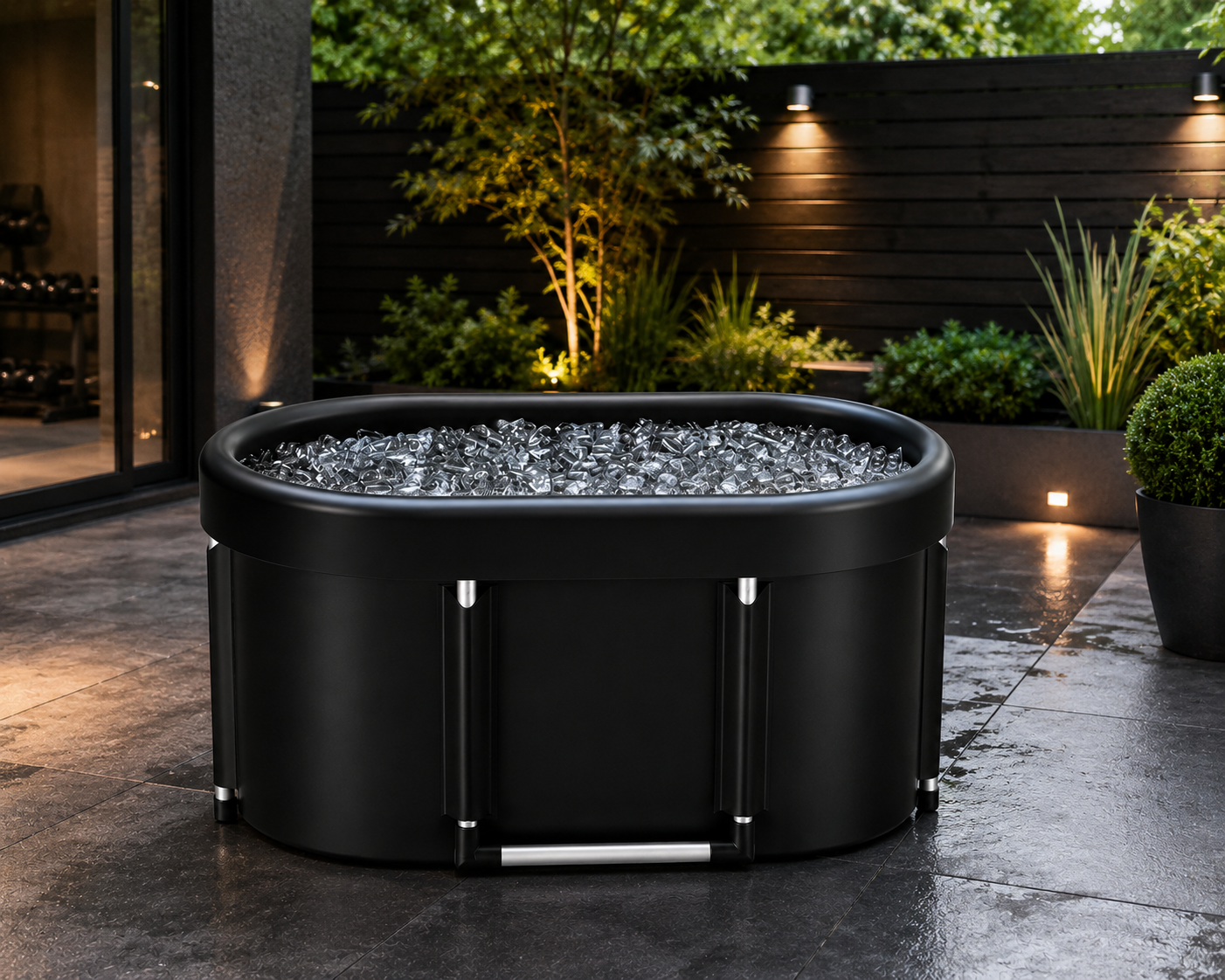
The PhaseChill™ Portable Ice Bath Recovery Tub is Phase One Recovery's cold recovery product — designed to bring controlled cold-water immersion into your home routine without the need for a permanent installation or a gym facility.
Here is what PhaseChill™ includes:
- 450L large oval design — a spacious cold-water recovery tub with an approximate length of 46 inches, giving you room to sit comfortably during sessions
- 7-layer insulated construction — designed to help retain cold water temperature for up to 4 hours, based on supplier information, so you can use it across multiple sessions without constantly replenishing ice
- Quick-drain outlet — makes emptying the tub straightforward after each session
- Foldable design — folds down for storage when not in use, making it practical for home gym, garage and garden setups
- Easy-clean surface — a waterproof, hard-wearing construction designed for regular use
- Complete set included — everything you need to get started is included in the box
PhaseChill™ is suitable for garden, patio, garage and home gym recovery spaces. It is designed for general wellness and recovery support as part of a controlled cold-water exposure routine — not as a medical treatment.
Heat, Compression and Cold: The Phase One Recovery System
PhaseChill™ sits within a broader Phase One Recovery range designed to support a complete home recovery routine. Each product targets a different aspect of recovery:
- Heat recovery — PhasePulse™, PhaseFlex™ and PhaseCore™ use targeted heat to support comfort and ease the feeling of tension in muscles and joints after activity
- Compression-style support — PhaseFlow™ and PhaseWrap™ use compression-style wraps to support the lower body, knees, calves and shoulders during and after active days
- Cold recovery — PhaseChill™ adds controlled cold-water immersion to the routine, completing a heat, compression and cold recovery setup at home
The Phase One range is designed to work together as a practical recovery system — not a medical programme. Each product is built for everyday use, at home, without complicated setups or clinic visits.
How to Use an Ice Bath Responsibly
If you are new to cold-water recovery, it is important to start gradually and use cold exposure responsibly. Here are some general guidelines:
- Start slowly — begin with shorter sessions at milder temperatures and build up gradually over time. Do not start with extreme cold or long immersion periods.
- Keep early sessions short — a few minutes is enough when starting out. There is no benefit to pushing through discomfort beyond your tolerance level.
- Do not force extreme temperatures — very cold water carries risks. Use a temperature that feels challenging but manageable, and adjust as you build experience.
- Avoid using alone when inexperienced — particularly in the early stages, it is advisable to have someone nearby when using cold-water immersion.
- Stop immediately if you feel unwell — exit the tub straight away if you feel dizzy, faint, numb, confused, excessively cold or unwell in any way.
- Warm up gradually afterwards — allow your body to return to its normal temperature gradually. Avoid jumping into a very hot shower immediately after cold immersion.
- Speak to a healthcare professional first if you are pregnant, or if you have heart conditions, high blood pressure, circulation issues, diabetes, nerve conditions or any other serious health concern. Cold-water immersion is not suitable for everyone.
This product is designed for general wellness and recovery support. It is not a medical treatment. Always use responsibly.
Who Is PhaseChill™ Best Suited For?
PhaseChill™ is designed for active people who want to add cold-water recovery to their home routine. It is particularly well suited for:
- Football players looking for a post-match or post-training cold recovery setup
- Runners building a structured recovery routine around their training schedule
- Gym users who want to complement their training with a cold-water wind-down
- Active workers with physically demanding days who want a practical home recovery option
- Home gym users building a complete recovery setup alongside their training space
- People who want a garden, patio or garage cold recovery setup without a permanent installation
- Customers building a full Phase One recovery routine combining heat, compression-style support and cold exposure
Frequently Asked Questions
How cold should the water be in an ice bath?
Most cold-water recovery routines use water between 10°C and 15°C (50°F–59°F). Beginners are advised to start at the higher end of this range and reduce temperature gradually as they build tolerance. Very cold water carries additional risks and should be approached with caution.
How long should I stay in an ice bath?
Beginners should start with sessions of 2–5 minutes and build up gradually. Most cold-water recovery routines involve sessions of between 5 and 15 minutes. Longer is not necessarily better, and you should always exit the tub if you feel unwell.
How often can I use PhaseChill™?
PhaseChill™ is designed for regular home use as part of a recovery routine. How often you use it will depend on your training schedule, activity level and personal preference. There is no fixed rule — use it as part of a structured routine that works for you.
Can I use PhaseChill™ outdoors?
Yes. PhaseChill™ is suitable for garden, patio, garage and home gym setups. Its portable, foldable design makes it practical for outdoor and indoor use on a flat, stable surface.
Is cold-water recovery suitable for everyone?
No. Cold-water immersion is not suitable for everyone. If you are pregnant, or if you have heart conditions, high blood pressure, circulation issues, diabetes, nerve conditions or any serious health concern, speak to a healthcare professional before use. Always use cold-water recovery responsibly and within your personal limits.
How does PhaseChill™ keep water cold?
PhaseChill™ uses a 7-layer insulated construction designed to help retain cold water temperature for up to 4 hours, based on supplier information. Adding ice to the water will help lower and maintain the temperature during your session.
Conclusion
Cold-water recovery is becoming a more common part of home training and active lifestyle routines — and for good reason. When used responsibly, controlled cold-water immersion can be a practical addition to a structured recovery setup alongside heat and compression-style support.
PhaseChill™ Portable Ice Bath Recovery Tub is designed to make that straightforward. A large 450L oval design, 7-layer insulated construction, quick-drain outlet and foldable build make it a practical cold recovery option for home use — whether that's in your garden, garage, patio or home gym.
It is not a medical treatment. It is a recovery tool — built for everyday use, as part of a complete Phase One recovery routine.
Explore the PhaseChill™ Portable Ice Bath Recovery Tub and build your cold recovery setup at home.
References
- PubMed — Systematic reviews on cold-water immersion and exercise recovery: pubmed.ncbi.nlm.nih.gov
- Frontiers in Physiology — Cold-water immersion after high-intensity exercise: frontiersin.org
- Sports Medicine — Meta-analysis on cold-water immersion and recovery methods: link.springer.com
- American Heart Association — Guidance on cold water risks: heart.org
- Cleveland Clinic — Cold plunge safety and risks: health.clevelandclinic.org

Leave a comment
This site is protected by hCaptcha and the hCaptcha Privacy Policy and Terms of Service apply.